

Klimatski Uvjeti Za Rast Od Cistanche Deserticola u Xinjiangu
Jun 11, 2024
Klima Haloxylon pustinja u Junggar bazenu je drugačija od onog u Unutarnjoj Mongoliji. Klima u Xinjiang karakterizira visokom intenzitetom i varijabilnošću, s drastičnom temperaturom promjenama rasponom od godine do godine, dan do dan, i međugodišnja. Klima u Suosuo Pustinja područje od Gar Bazen je nisko u sjeveru i visoko u jugu, nisko u planinama i visoko u u ravnice. Okolica područja ravnice su također niže od središte, kako prikazano u Slika 2-1}. godišnja prosječna temperatura u ravnica područja je pozitivna, s %5-9 stupanj u sjeverni Xinjiang i 10-11 stupanj u južni Xinjiang.

Cistanche deserticola Y.C.Ma
The average temperature in the hottest month (July) is 20-25 degree in northern Xinjiang and 25-30 degree in southern Xinjiang. Winter is extremely cold, with an average temperature of -15~-20 degree in northern Xinjiang and -7~-15 degree in southern Xinjiang in January. The annual sunshine hours range from 2600 to 3600 hours, with an average sunshine percentage of 60% to 80% and a maximum of 70% to 90%. In southern Xinjiang, the accumulated temperature of Greater than or equal to 10 degree reaches 3500 to 4500 degree . The negative accumulated temperature in southern Xinjiang ranges from -400 degree to -1000 degree , for only 80-100 days. The precipitation also varies significantly among different regions, with a distribution trend of more in northern Xinjiang and less in southern Xinjiang, more in mountainous areas, and less in basins. Due to the obstruction of the western Junggar Mountains, the northern foothills of the Tianshan Mountains receive very little precipitation, less than 200 millimeters. In Fukang, from Jimusar to Qitai and its eastern areas, there is less precipitation, less than 200 millimeters. The central part of the Junggar Basin is the least rainy area in northern Xinjiang, with an annual precipitation of only about 100 mm, as shown in Figure 2-2 and Figure 2-3.

Cistanche deserticola Y.C.Ma
The vegetation climate characteristics of the Suoshuo Desert in Junggar are similar to those of Inner Mongolia, where summer rain is concentrated, spring and autumn rain is less, and winter rain is present. A lack of rain in spring and autumn is not suitable for the growth and cultivation of short-lived plants. They can only develop shrubs, small shrubs, and plants with a one-year growth period that are nutritious in summer. Under the climatic conditions of this area, there are small semi-shrub deserts that grow shrubs and annual plants with long nutrient periods. The shrubs in the growth areas of Inner Mongolia's salt-living Cistanche deserts include the Sihemu Desert, the Red Sand Desert, the Bawang Desert, the Pearl Chai Desert, the Suo Suo Desert, the Sand Holly Desert, and the White Thorny Desert.

Cistanche deserticola Y.C.Ma
U Suo Suo Pustinja od Xinjiang, pustinja pustinja parazitira. The biljka sastav Suo Suo Pustinja je uglavnom sastavljena od izlučivanje soli mali grmlje kao kao Pipa Chai (crvena pijesak), Sol Kandža Kandža, Bez lišća Netočno Equisetum, Sol Uho Drvo, Deva Lilium, Artemisia biljke, Goji bobice, i Salsola.

Cistanche deserticola Y.C.Ma
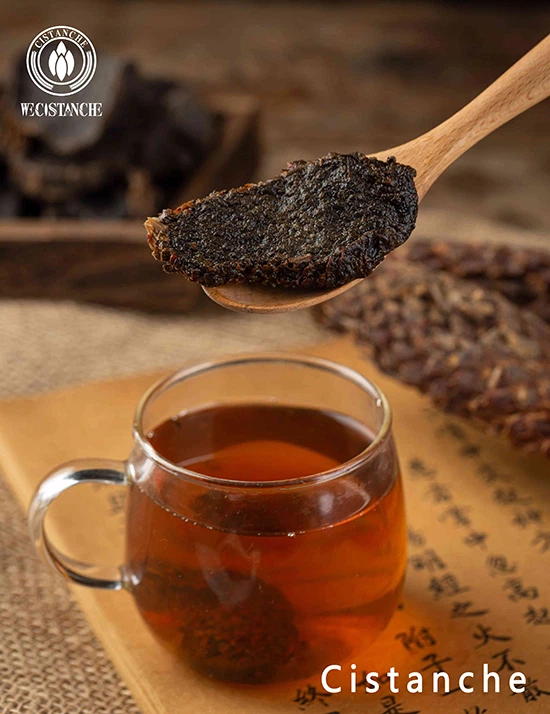
Cistanche deserticola čaj
Klikni ovdje za pogled Cistanche deserticola čaj proizvodi
【Pitaj za više】 E-pošta:cindy.xue@wecistanche.com / Što Aplikacija: 0086 18599088692} / Wechat: 18599088692
Mogli biste i voljeti
-

Ekstrakt morske alge u prahu
-

Dodatak Cistanche Tubulosa poboljšava memery
-

Dodatak Enhnche Memory Funciton Cistanche Tubulosa
-

Cistanche Dodatak prehrani Antioksidacijska potpora Fenil...
-

Cistanche Dodatak prehrani Poboljšanje kognitivnih funkci...
-

Cistanche Dodatak prehrani Poboljšanje seksualne izvedbe ...